
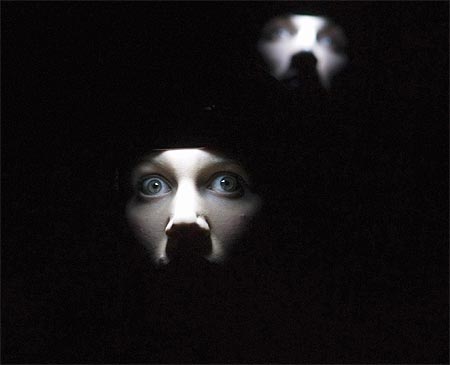
In a landmark research, neuroscientists have located the neurons responsible for fear conditioning in the mammalian brain, a development that will facilitate better understanding and treatment for human phobias and anxiety disorders.
Researchers at the University of Washington used an imaging technique, which enabled them to trace the process of neural activation in the brains of rats, to pinpoint the basolateral nucleus in the region of the brain, called the amygdala, as the place where fear conditioning is encoded.
Revealed: Why fear is the key

Photographs: Carlos Garcia Rawlins/Reuters
Fear conditioning is a form of Pavlovian, or associative, learning and is considered to be a model system for understanding human phobias, post-traumatic stress disorder and other anxiety disorders.
Based on the study of rats, the research was designed to look for where information about conditioned and unconditioned stimuli converges in the brain as fear memories are formed.
Revealed: Why fear is the key

Photographs: Bazuki Muhammad/Reuters
Bernstein, a professor of psychology at the University of Washington, said people have phobias that often are set off by cues from something bad that happened to them, such as being scared by a snake or being in a dark alley. 'So they develop an anxiety disorder,' she said.
Revealed: Why fear is the key

Photographs: Mohammed Ameen/Reuters
However, the latest study research suggests that the role of the hippocampus is to process and transmit information about conditioned stimuli to the amygdala, Bernstein said.
Revealed: Why fear is the key

Photographs: Yonathan Weitzman/Reuters
She said by understanding the process of fear conditioning 'we might learn how to treat anxiety by making the conditioning weaker or to go away'.
'It is also a tool for learning about these brain cells and the underlying mechanism of fear conditioning,' Bernstein underlined.

article